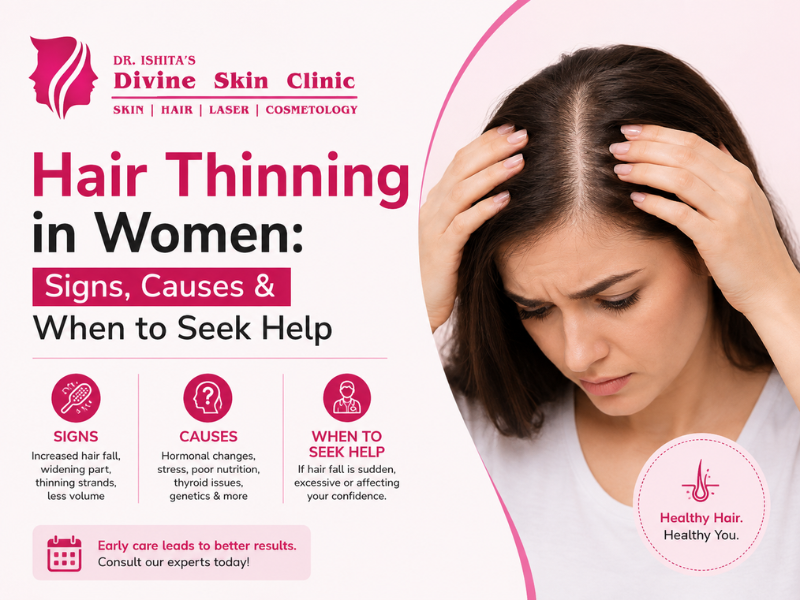
Hair thinning in women can develop slowly, so it is not always easy to notice in the beginning. You may see more hair on your pillow, notice a wider hair part, or feel that your ponytail has become thinner.
Occasional hair fall can be normal. However, continued thinning may be a sign that your hair or scalp needs professional attention.
Understanding the early signs of hair thinning in women can help you seek the right advice at the right time. If you are experiencing persistent hair loss, a dermatologist can help identify the possible cause and suggest a suitable treatment plan.
What Is Hair Thinning in Women?
Hair thinning means a gradual reduction in the amount or thickness of hair.
It can affect the entire scalp or become more noticeable in specific areas. In some women, thinning is most visible around the centre part of the scalp. In others, the hairline or overall hair density may change.
Hair thinning is different from occasional hair shedding. Losing some hair every day can be part of the normal hair growth cycle. Concern usually increases when hair fall continues, hair becomes visibly thinner, or new hair does not seem to replace the lost hair.
Early Signs of Hair Thinning in Women
Recognising the early signs can help you take action before the problem becomes more noticeable.
1. Wider Hair Part
One of the common early signs is a widening of the hair part.
If the scalp becomes more visible along the centre part than it was previously, it may indicate reduced hair density.
2. Thinner Ponytail
You may notice that your ponytail feels smaller or less full.
This can happen gradually and may be easier to notice when comparing older photographs with recent ones.
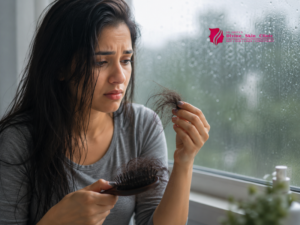
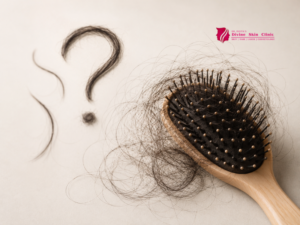
3. More Hair on Your Pillow or Comb
A temporary increase in hair shedding can happen after stress, illness, or other changes.
However, if you consistently notice more hair than usual on your pillow, comb, brush, or in the shower, it may be worth discussing with a dermatologist.
4. Scalp Becoming More Visible
If your scalp becomes easier to see under normal lighting, especially around the top or centre of the head, this can be a sign of reduced hair density.
5. Hair Feels Finer
Sometimes the number of hairs may not appear dramatically different, but individual strands may feel finer or weaker.
This can make the overall hair look less full.
6. Hair Growth Seems Slower
If your hair appears to take longer to regain its usual length or fullness, it may be useful to look at the overall pattern rather than focusing only on daily hair fall.
Common Causes of Hair Thinning in Women
Hair thinning can have many possible causes. Identifying the cause is an important part of choosing the right treatment.
Hormonal Changes
Hormonal changes can affect the hair growth cycle.
Hair thinning may occur around pregnancy, after childbirth, during certain stages of life, or with other hormonal changes.
If hair loss continues or becomes significant, professional evaluation can help identify the possible cause.
Stress
Physical or emotional stress can sometimes be followed by increased hair shedding.
The hair fall may not appear immediately after the stressful event. This can make it difficult to connect the two.
If you notice increased shedding after a period of significant stress, speak with a dermatologist if it continues.
Nutritional Problems
Hair health can be affected when the body does not receive adequate nutrition.
Low levels of certain nutrients may contribute to hair problems in some people.
If nutritional deficiency is suspected, a healthcare professional can decide whether further evaluation is needed.
Family History
Some women may experience hair thinning because of inherited factors.
This type of thinning can develop gradually and may become more noticeable over time.
A dermatologist can assess the pattern and help determine whether family history may be contributing to the problem.
Scalp Conditions
Problems affecting the scalp can also influence hair growth.
Itching, scaling, redness, or persistent dandruff may indicate a scalp concern that needs attention.
Treating the scalp condition may be an important part of managing the hair problem.
Certain Medicines or Health Conditions
Some medicines and health conditions can be associated with increased hair shedding.
If your hair loss started after a new medicine or during a health problem, inform your doctor or dermatologist.
Do not stop prescribed medicine without medical advice.
Hair Thinning After Pregnancy
Many women notice increased hair shedding after childbirth.
This can happen because hormonal changes affect the normal hair growth cycle.
For some women, the shedding gradually improves with time. However, if hair thinning continues, becomes severe, or is accompanied by other symptoms, a dermatologist can help determine whether another cause may be involved.
When Should Women See a Dermatologist for Hair Thinning?
You do not need to wait until significant hair loss occurs before seeking professional advice.
Consider consulting a dermatologist if:
- Hair fall continues for several weeks
- Your hair is becoming visibly thinner
- Your centre hair part is getting wider
- Your ponytail has become noticeably thinner
- You are losing hair in patches
- Your scalp is itchy, red, painful, or inflamed
- You notice sudden or heavy hair shedding
- Hair thinning is affecting your confidence
- Home care is not improving the problem
Early evaluation can help identify the possible cause and guide the next steps.
How Is Hair Thinning Evaluated?
A dermatologist may begin by asking about your hair fall, health history, lifestyle, recent changes, and family history.
The scalp and hair are then examined to understand the pattern of thinning.
Depending on your symptoms, your doctor may recommend further evaluation.
The goal is not simply to reduce hair fall. It is to understand why the hair is thinning and select an appropriate approach.
Treatment for Hair Thinning in Women
Treatment depends on the cause.
A dermatologist may recommend different approaches depending on the individual situation.
These may include:
- Treating an underlying scalp condition
- Addressing nutritional concerns when identified
- Managing factors that contribute to hair shedding
- Using suitable hair and scalp care
- Medical treatments when appropriate
- Professional hair restoration treatments for selected patients
One treatment does not work for every type of hair thinning.
For this reason, it is better to avoid choosing a treatment only because it worked for someone else.
If you are looking for hair loss treatment in Agra, professional assessment can help you understand which approach may be appropriate for your condition.
You can also explore hair and hair restoration treatments at Divine Skin Clinic.
Can PRP Help With Hair Thinning in Women?
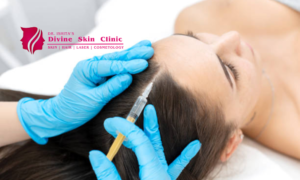
PRP is one of the treatment options that may be considered for certain types of hair thinning.
It uses a person’s own blood components and is designed to support the natural hair growth process.
However, PRP is not suitable for every type or stage of hair loss.
A dermatologist should first evaluate the scalp and hair pattern to determine whether PRP may be appropriate.
You can learn more about PRP hair treatment in Agra.
Simple Hair Care Tips for Women With Thinning Hair
Good hair care can help reduce unnecessary damage to the hair.
Consider these simple habits:
- Avoid very tight hairstyles
- Be gentle while brushing wet hair
- Avoid frequent excessive heat
- Choose gentle hair care products
- Avoid unnecessary chemical treatments
- Maintain a balanced diet
- Manage stress as much as possible
- Follow your dermatologist’s advice
These habits may support healthier-looking hair, but they cannot replace treatment for an underlying medical cause.
Why Choose a Dermatologist for Hair Thinning in Agra?
Hair thinning can have different causes, so personalised assessment is important.
At Dr. Ishita’s Divine Skin Clinic, Agra, hair and scalp concerns are evaluated according to the individual’s condition.
Dr. Ishita Raka Pandit is a dermatologist, aesthetic dermatologist, dermatosurgeon, and trichologist with more than 11 years of experience in dermatology and aesthetic medicine.
You can learn more about Dr. Ishita Raka Pandit and her areas of expertise.
Frequently Asked Questions About Hair Thinning in Women
Is hair thinning normal in women?
Some daily hair shedding can be normal. However, continuous shedding, visible thinning, a widening hair part, or sudden hair loss should be evaluated.
What is the most common cause of hair thinning in women?
There is no single cause for every woman. Hormonal changes, inherited factors, stress, nutritional problems, scalp conditions, and certain health issues can all contribute.
Can stress cause hair thinning?
Yes, significant physical or emotional stress can sometimes be followed by increased hair shedding. If the problem continues, a dermatologist can help identify other possible causes.
Can hair thinning after pregnancy improve?
Post-pregnancy hair shedding may improve gradually for many women. If the thinning continues or becomes significant, professional evaluation can help rule out other causes.
Can PRP help women with hair thinning?
PRP may be considered for some types of hair thinning. Its suitability depends on the cause and stage of hair loss, so a dermatologist should assess the condition first.
When should I see a dermatologist for hair thinning?
You should consider seeing a dermatologist when hair fall continues, becomes sudden or heavy, creates visible thinning, causes patchy hair loss, or occurs with scalp symptoms.
Can changing shampoo stop hair thinning?
Changing shampoo alone usually cannot address the underlying cause of hair loss. A suitable hair care routine can help reduce damage, but persistent thinning may need professional evaluation.
Can hair thinning be prevented?
Prevention depends on the cause. Healthy nutrition, gentle hair care, avoiding excessive tension and heat, and addressing scalp problems early may help protect hair health.
Book a Hair Consultation in Agra
Hair thinning can be easier to manage when the cause is identified early.
If you are noticing a wider hair part, a thinner ponytail, increased shedding, or visible scalp, consider getting your hair and scalp evaluated by a dermatologist.
Book a consultation with Dr. Ishita Raka Pandit at Divine Skin Clinic, Agra, to understand the possible cause of your hair thinning and discuss suitable treatment options.
Dr. Ishita’s Divine Skin Clinic
13/14, IIIrd Floor, Shanti Madhuban Plaza, Delhi Gate Road, adjacent to Pushpanjali Hospital, Agra, Uttar Pradesh 282002
Call: +91 8287139498
Email: drishitadivineskinclinic@gmail.com
Disclaimer: This article is for general information only and should not be considered medical advice, diagnosis, or treatment. Hair thinning can have different causes. Consult a qualified dermatologist for an appropriate evaluation and treatment plan.