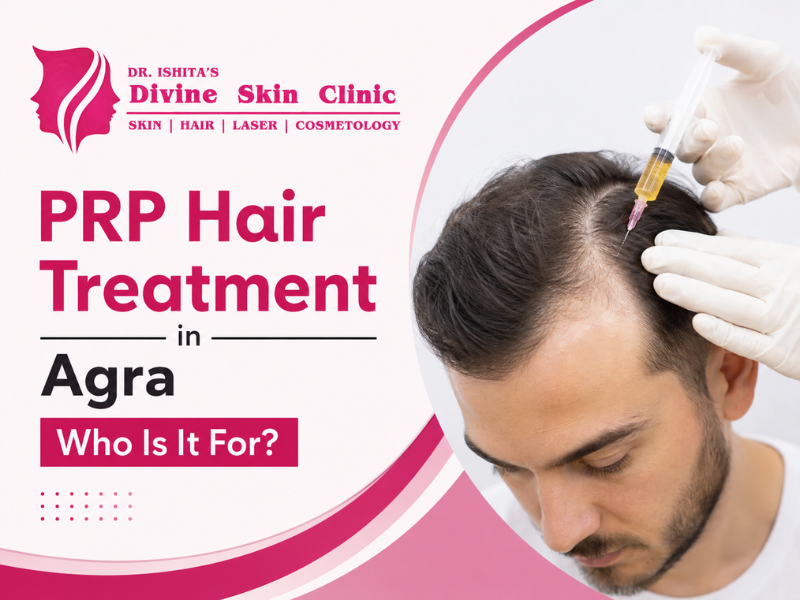
Hair thinning and excessive hair fall can affect both men and women. While some daily hair shedding is normal, persistent thinning, reduced hair density, a widening hair part, or a receding hairline may indicate a condition that needs professional evaluation.
PRP hair treatment in Agra is one option that may be considered for certain types of hair loss. PRP stands for platelet-rich plasma and uses components of a person’s own blood to prepare a concentrated plasma product that is injected into selected areas of the scalp. The aim is to support the hair follicles and encourage healthier hair growth.
However, PRP is not suitable for every type of hair loss. A dermatologist should first identify the likely cause, assess the scalp and hair follicles, and determine whether PRP is appropriate. Divine Skin Clinic in Agra lists PRP among its hair-restoration treatments and describes personalised treatment planning based on individual needs.
What Is PRP Hair Treatment?
PRP, or platelet-rich plasma, is prepared from a small sample of the patient’s blood. The sample is processed to separate plasma containing a higher concentration of platelets. This prepared plasma is then injected into selected areas of the scalp.
Platelets contain growth-related substances that may support tissue repair and cellular signalling. In hair restoration, PRP is used with the goal of supporting the activity and health of hair follicles.
The procedure does not instantly create new hair. Hair growth is a gradual biological process, so any improvement develops over time.
How Does PRP Hair Treatment Work?
A typical PRP treatment involves three main steps:
1. Blood Collection
A small amount of blood is collected from the patient, similar to a routine blood sample.
2. PRP Preparation
The blood is processed using a centrifuge to separate the plasma and concentrate the platelets.
3. Scalp Injections
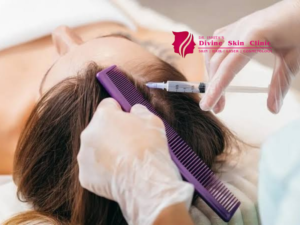
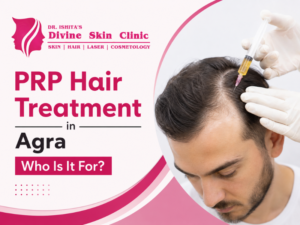
The prepared PRP is injected into selected areas of the scalp where thinning or reduced hair density is present.
The exact technique, preparation method, injection pattern, and treatment schedule can vary according to the patient’s condition and the dermatologist’s protocol. Divine Skin Clinic describes scalp assessment, blood collection, processing, and targeted scalp injections as part of its PRP treatment process.
Who Is a Good Candidate for PRP Hair Treatment?
PRP may be considered for people with certain types of hair thinning or early-stage hair loss.
A dermatologist may consider PRP for:
- Men with early or moderate hair thinning
- Women experiencing reduced hair density
- People with early hereditary hair loss
- Patients who want a non-surgical hair-restoration option
- People whose hair follicles are still capable of responding to treatment
The important factor is not simply how much hair has been lost. The cause and stage of hair loss also matter.
If hair loss is caused by a nutritional problem, hormonal condition, scalp disorder, medication, severe illness, or another underlying issue, treating that cause may be an important part of the overall plan.
Who May Not Be Suitable for PRP?
PRP is not a universal solution for hair loss.
It may be less appropriate when:
- Hair follicles have been permanently damaged
- Hair loss is very advanced
- There is an active scalp infection
- Certain blood-related conditions are present
- Certain medications or medical conditions affect suitability
The clinic’s PRP information specifically lists active infections, certain medical conditions, and some blood-thinning medications among situations requiring caution or avoidance.
A consultation is therefore important before deciding to undergo PRP.
What Are the Benefits of PRP Hair Treatment?
When PRP is appropriate for the underlying type of hair loss, possible benefits may include improvement in hair thickness and density over time.
Potential benefits include:
Supports Hair Follicle Activity
PRP is intended to provide growth-related signals around treated follicles and support their activity.
May Improve Hair Density
Some patients may experience an improvement in the appearance of thinning areas as hair becomes thicker or denser.
Uses the Patient’s Own Blood
Because PRP is prepared from the patient’s own blood, it does not involve introducing a completely unrelated biological material into the scalp.
Minimally Invasive
PRP involves injections rather than surgical hair transplantation. The clinic describes the procedure as having minimal downtime.
Can Be Considered for Men and Women
PRP may be considered for suitable men and women with certain forms of hair thinning.
It is important to remember that these are potential benefits, not guaranteed outcomes. Results differ according to the cause of hair loss, follicle condition, treatment protocol, and individual response.
How Many PRP Sessions Are Needed?
There is no single session schedule that works for everyone.
The treatment plan depends on the extent and cause of hair loss, scalp condition, and the patient’s response. Divine Skin Clinic’s PRP page states that a series of treatments may be recommended, with maintenance treatment considered when appropriate.
Rather than choosing a fixed number of sessions based on an online package, it is better to have your scalp assessed and follow a treatment schedule recommended for your condition.
When Can You Expect PRP Results?
PRP does not provide overnight hair growth.
Hair follicles require time to move through their growth cycle, so results develop gradually. Some people may first notice changes in hair shedding or hair quality, while visible changes in density can take longer.
The clinic states that initial hair-growth improvements may become visible around 8–12 weeks after starting treatment, with fuller and stronger-looking hair potentially becoming more noticeable over several months. Individual results can vary.
A realistic expectation is important: PRP aims to improve the appearance and condition of suitable thinning hair; it cannot guarantee complete regrowth.
Is PRP Hair Treatment Painful?
PRP involves multiple small injections into the scalp, so mild discomfort or a pinprick sensation can occur.
Some patients may experience temporary:
- Redness
- Tenderness
- Mild swelling
- Bruising
- Sensitivity around injection sites
These effects generally settle with time, although individual experiences vary.
A dermatologist can explain the expected discomfort and aftercare before the procedure.
What Should You Do After PRP Treatment?
Your dermatologist will provide personalised aftercare instructions. Depending on the treatment protocol, you may be advised to:
- Avoid unnecessary touching or scratching of the scalp immediately after treatment
- Follow recommended hair-washing instructions
- Avoid products that may irritate the treated area
- Follow the recommended treatment schedule
- Report unusual or persistent symptoms to your healthcare professional
Following aftercare instructions can help support a comfortable recovery.
PRP vs Hair Loss Treatment: Why Diagnosis Comes First
PRP should not be viewed as a replacement for diagnosing hair loss.
Hair fall can occur because of hereditary factors, stress, hormonal changes, nutritional issues, illness, scalp conditions, and other causes. Divine Skin Clinic also states that treatment options for hair loss may include medication, PRP, mesotherapy, nutritional guidance, and other hair-restoration procedures depending on the cause.
This is why the right approach starts with a consultation rather than immediately choosing a procedure.
If you are experiencing persistent hair fall, a dermatologist may examine your scalp, review your medical and hair-loss history, and recommend further evaluation when required.
How Can You Support Hair Health Alongside PRP?
Professional treatment works best when supported by sensible hair-care habits.
Consider:
- Eating a balanced diet with adequate protein
- Avoiding crash diets
- Managing ongoing stress
- Avoiding unnecessarily tight hairstyles
- Limiting excessive heat and chemical treatments
- Handling wet hair gently
- Following your dermatologist’s treatment and aftercare recommendations
If you are experiencing ongoing hair fall, you can also learn more about Hair Loss Treatment in Agra and the different causes that may contribute to thinning.
Frequently Asked Questions
1. Is PRP effective for hair loss?
PRP may help selected patients with certain types of hair thinning, but results vary. Its suitability depends on the cause and stage of hair loss and the condition of the hair follicles.
2. How many PRP sessions are needed for hair growth?
The number of sessions varies according to the patient’s condition and treatment protocol. A dermatologist can recommend an appropriate schedule after assessing the scalp and hair loss pattern.
3. How long does PRP take to show results?
PRP results develop gradually rather than immediately. Early changes may become noticeable after several weeks, while more visible changes in hair thickness or density can take several months.
4. Can PRP stop hair fall permanently?
PRP cannot guarantee permanent results or stop every type of hair loss. Hair loss can have different causes, and long-term management may require treatment of the underlying condition as well as maintenance therapy.
5. Is PRP suitable for both men and women?
Yes. PRP may be considered for both men and women with certain types of hair thinning. However, a dermatologist should assess the cause and stage of hair loss before recommending treatment.
PRP Hair Treatment in Agra at Divine Skin Clinic
If you are searching for PRP hair treatment in Agra, choosing the procedure should begin with understanding your hair-loss condition.
At Dr. Ishita’s Divine Skin Clinic in Agra, PRP is offered as part of the clinic’s hair-restoration services. The clinic describes personalised treatment plans and scalp assessment before treatment.
The clinic is located at 13/14, IIIrd Floor, Shanti Madhuban Plaza, Delhi Gate Road, adjacent to Pushpanjali Hospital, Agra.
Ready to Understand Your Hair Loss?
If you are noticing increasing hair fall, reduced density, a widening part, or early thinning, don’t choose a treatment based only on someone else’s results.
Book a consultation at Divine Skin Clinic in Agra to have your scalp and hair-loss pattern assessed and find out whether PRP may be appropriate for you.
Explore PRP Hair Treatment in Agra or visit Divine Skin Clinic to take the next step